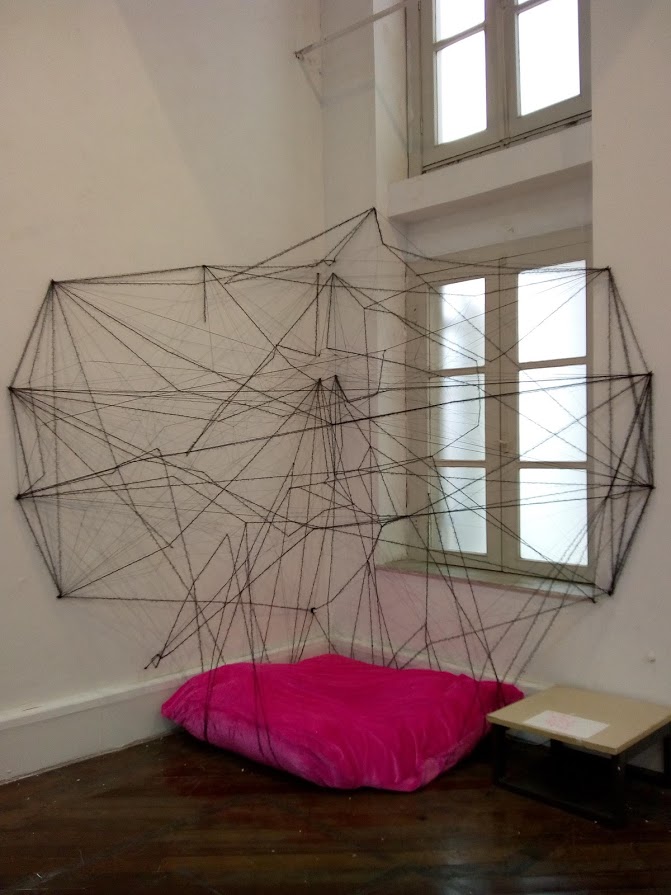
Cama de gato (Cat's Cradle) is the culmination of an artistic research done through observation, interaction, and registering cohabiting with domestic cats. This research revolves around the concept of chiasma as developed by Maurice Merleau-Ponty; here, the tangential point between the touching body and the touched body is explored by means of experience. This experience, in the beginning, took the shape of something almost performance-like by sheer accident, with the intent of searching for the Cat-Being-in-the-World. A fur coat, a furry scarf, a big plush sofa — everything invites touch. Objects covered with plush, plushies inserted in spaces, practical experiments with furry clothing, furry photographies, a work of a lifetime.
Cat’s Cradle, finally, comes from the desire to see life as a cat; the idea of creating an organic ambient smushed into a corner (like cats do). An amorphous mass, a place that doesn’t just belong to the metaphorical cat but that is in itself a cat-place, a cat-corner, a space that’s reminiscent of the existence of felines. It’s a space where everything is Cat: the confined space, the physical threads and the shadow threads (shadows are visual illusions, as Merleau-Ponty would put it, like colours are), the texture of the mattress, the sounds and the feelings.
Through this, the installation provokes an experience in which, even if only for a brief moment, the spectator-participant feels cat. Cat’s Cradle is composed of a big handmade mattress covered in soft, furry, neon pink tissue — an almost-inorganic colour, not as widely seen in nature and definitely not in felines — set up in a corner and covered by threads, as cats often do in their apartments, cat towers, etc. The tangible interaction concludes with two small built-in speakers that emit sounds, soft and loud, raising questions about the feasibility of constructing complex communication with animals. This serves the purpose of horizontalizing the structure that positions humans as inherently superior mammals, but also to quench the thirst the Superior Being always feels for understanding the experience of the Inferior one.
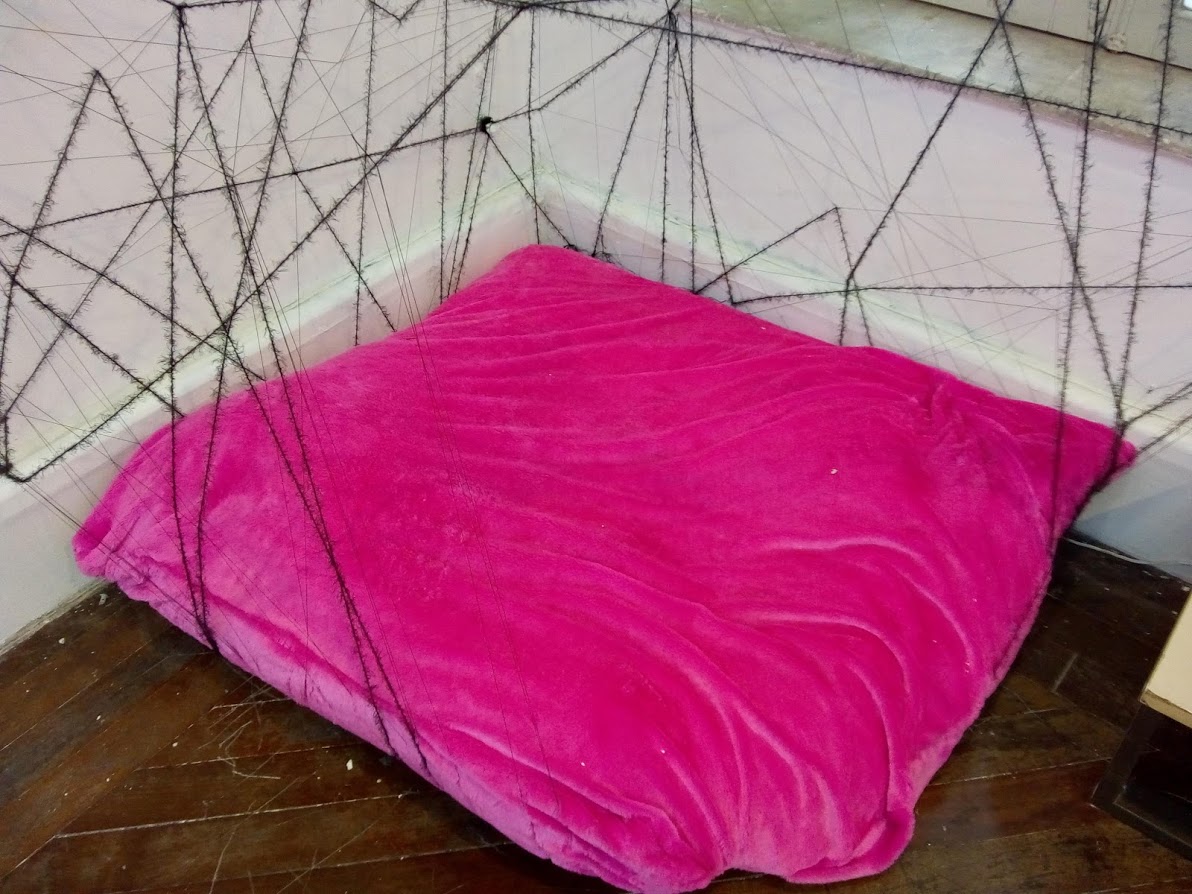
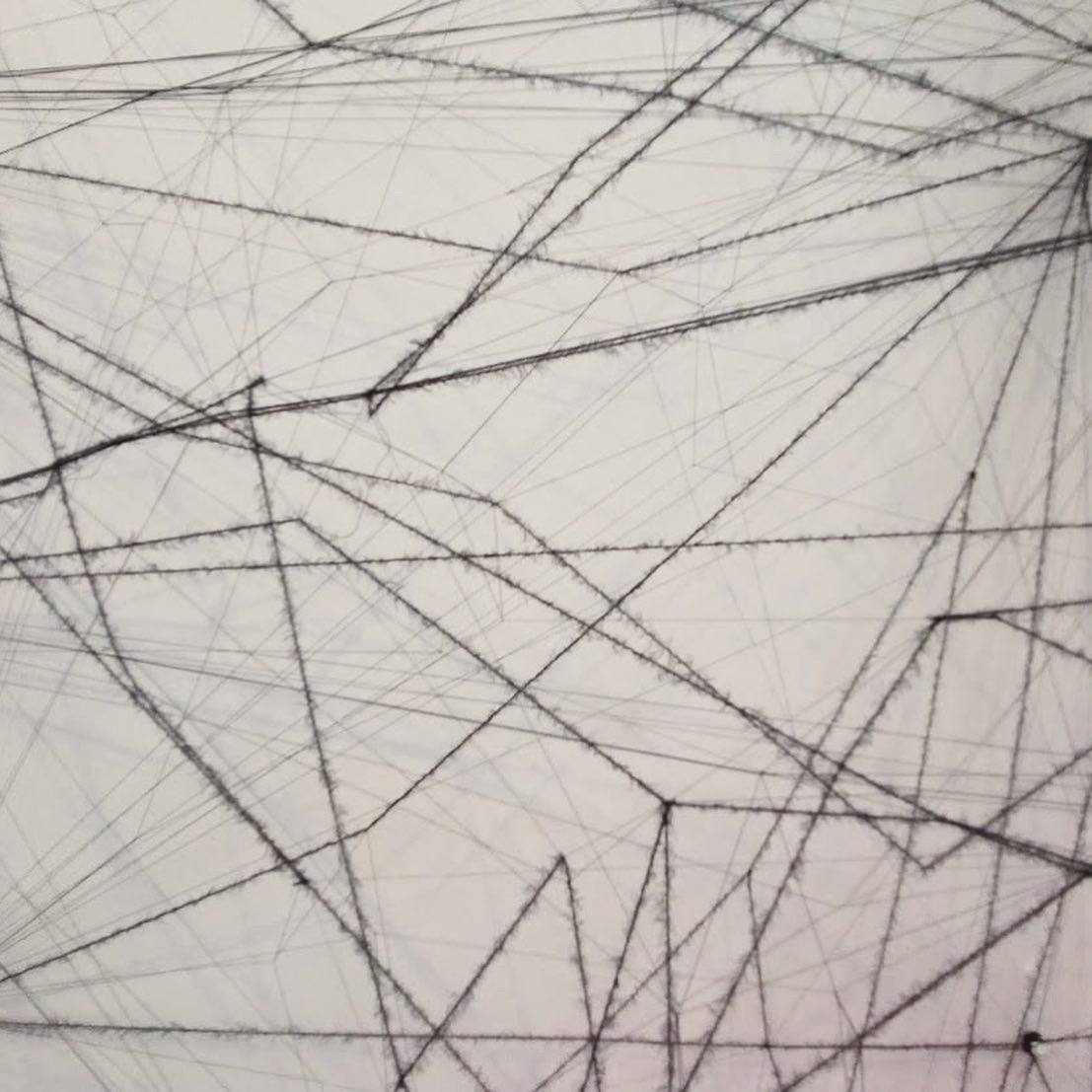
The threads are structured like the children’s game Cat’s Cradle, and they’re analogous to the screens often used in houses where cats inhabit. Through the empty spaces between the lines, air and light come in, making the cage a semi-open space; a small oasis of serenity and softness in a place as rigid as an exhibition room. The two small speakers, strategically positioned in different corners of the mattress, emit different sounds. One is organic: meows and cat vocalizations, purrs, calls, bringing to the ambient a more material presence of the animal and allowing the participant to connect themselves to being-cat. The second speaker, however, is a cacophony of organic and non-organic aggressive sounds completely opposed to the idea of softness: crystals breaking, heavy waterfalls, woodcutters, thunder.
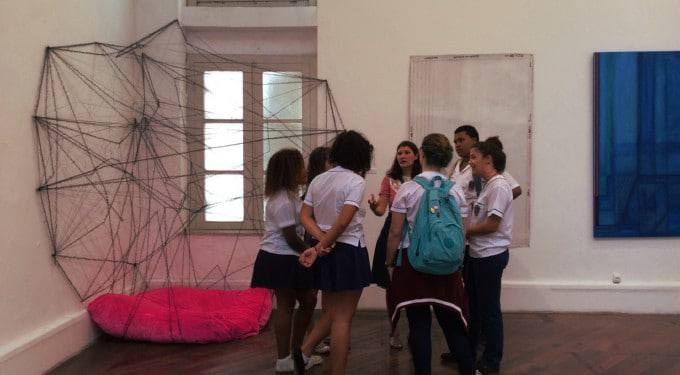
Cat’s Cradle is, in the end, the way children pass threads one to another without dismantling the structure. But, because it’s child’s play, the threads are irregular and complex, unpredictable and disastrous. The work, confined to an angular corner of the room, is both a place of relief — no man is an island, but this one is another being’s island — and a reminder of the lack of relief being constantly a human is.
The three elements that compose the work are; then: the mattress (the body), the sounds (the language), and the threads (the apartment). By allowing the public to enter the installation but by forcing them to do so on their knees, which in Portuguese is “engatinhar” (coming from “gato”), the work is the cat-being’s favourite and only pillow. In the process of immersion in a velvety, soft world, with such comforting touch, the idea is to allow the spectator to experiment with new ways of living environments and dissociate themselves from human reality, from anthropocentrism, and leave Homo sapiens sapiens out of the door, just like their shoes.
Cama de gato é fruto de uma pesquisa artística feita através da observação, registro e interação com os gatos domésticos. Com base na ideia de um quiasma, o ponto tangencial entre quem palpa e o objeto palpado é explorado por meio de uma experiência quase que acidentalmente performática, realizada com o intuito de vivenciar uma experiência-gato de ser-no-mundo. Um casaco de pelúcia, um cachecol de pêlo, um grande pufe felpudo - tudo chama o toque. Objetos recobertos de pelúcia, bichos de pelúcia inseridos em espaços, experiências práticas com vestimentas felpudas, fotografias felinas, um trabalho de vida inteira. Surge do desejo de ver a vida como gato a escolha de criar um ambiente orgânico prensado contra um canto; uma massa disforme, um local que não só pertença ao gato imaginado, mas que seja um lugar-gato, um canto-gato, um espaço reminiscente da existência dos animais. A ideia da Cama de Gato é de proporcionar um espaço onde tudo seja gato: o espaço enclausurado, as teias físicas e as teias de sombra (também ilusão visual, como as cores de Merleau-Ponty), a textura do pufe, os sons e a sensação. Desta forma, é proporcionada uma experiência onde, por mesmo que um breve espaço no tempo, o espectador-participante se sinta gato. A Cama de Gato é composta por um grande pufe de pelúcia sedosa rosa - cor quase-inorgânica, não tão vista na natureza mas tão real quanto todas as outras, manifestação do espectro visível aos olhos humanos - disposto em um canto e coberto por teias, como um gato dentro de um apartamento. A interação palpável se completa com uma interação sonora, os miados, questionando as possibilidades para o estabelecimento de uma comunicação complexa com os animais, a fim tanto de uma horizontalização da estrutura que posiciona o ser humano como um bicho inerentemente superior aos de outras espécies como também do comedimento da curiosidade que surge de saber como é a vida por trás dos olhos de um outro ser vivo.
A teia, de material elástico, é análoga às telas utilizadas nas janelas das casas, mero impedimento para a defenestração de animais domésticos (ou crianças pequenas – qual é a diferença entre as duas categorias, levando em consideração não só o Kindenschema, mas também a vulnerabilidade e pequenez das espécies?). Pelos espaços vazios no entremeamento das linhas, entra luz e ar, proporcionando um ambiente semiaberto, como um pequeno oásis de serenidade e maciez em um lugar tão rígido, uma instituição regida pela meticulosidade: o espaço expositivo. Escondidas no rodapé da sala, duas caixas de som posicionadas estrategicamente nas laterais do pufe emitem sons distintos. Uma emite sons orgânicos, miados e vocalizações dos gatos, ronrons, protestos, trazendo ao ambiente uma presença mais material do bicho e proporcionando ao espectador que esse se conecte de maneira mais literal ao ser-gato. A outra, colocada em oposição à primeira, traz sons inorgânicos agressivos sobrepostos a sons orgânicos catastróficos (chuva, trovão, violência da cachoeira), como um lembrete da fragilidade – cristais quebrando, ruídos ocos – e do caos que floresce tanto na disposição da teia-teto da instalação como nas conglomerações urbanas e também no jogo do nome da obra.
“Cama de gato”, afinal, é uma brincadeira infantil que consiste no embaraçamento de fios entre os dedos das mãos para formar figuras e passar o barbante para o outro jogador sem desmanchá-lo, derivando daí o significado de trama. Tramas irregulares e complexas, imprevisíveis e desastrosas. Desta maneira, a obra, incrustada em um ponto angular da sala, se apresenta como um canto de alívio, uma quase-ilha de outra espécie, ao mesmo tempo que é um lembrete do que é a vida no exterior daquele espaço. Os três elementos que compõem a obra, então, dividem-se: o pufe (o corpo), os sons (a linguagem) e as telas (o apartamento). Ao permitir a entrada do público e exigir que esta seja realizada em um engatinhado, jogando também com a maneira de andar/verbo que recebe o nome da caminhada dos felinos, a instalação em si se torna a cama para o ser[gato] que nela adentra. E, no processo de imersão em um mundo aveludado, de toque tão confortante, a pretensão é de proporcionar ao espectador a dissociação da sua realidade humana, do antropocentrismo encrustado na mente, e fazer com que ali, mesmo que por pouco, o Homo sapiens deixe sua presumida superioridade do lado de fora junto com seus sapatos, horizontalizando sua relação com os animais domésticos e experimentando novas sensações de ambiente.